
Interurban Project in Hamburg A7
There are projects that go far beyond what everyday infrastructure construction typically involves. Projects that demand technical creativity, the courage to develop special solutions, and that truly put a team’s experience to the test. SWARCO Traffic Systems GmbH from Haiger delivered exactly such a project on the A7 near the Port of Hamburg: the installation of 20 overhead sign gantries—so-called traffic sign bridges—along one of Germany’s busiest motorway sections, including the longest structure ever installed across a motorway bridge anywhere in the country.
What started as a simple request from a steel manufacturer quickly developed into one of the most challenging undertakings the team around project manager Phillipp Groos has faced in their entire careers. Since 2021, SWARCO has been involved in the planning phase in an advisory role, working together with steel contractor Pons and main contractor STRABAG to verify the technical feasibility of these massive structures. It soon became clear that SWARCO was not dealing with a routine job, but with a project in which nearly every location would tell its own story.
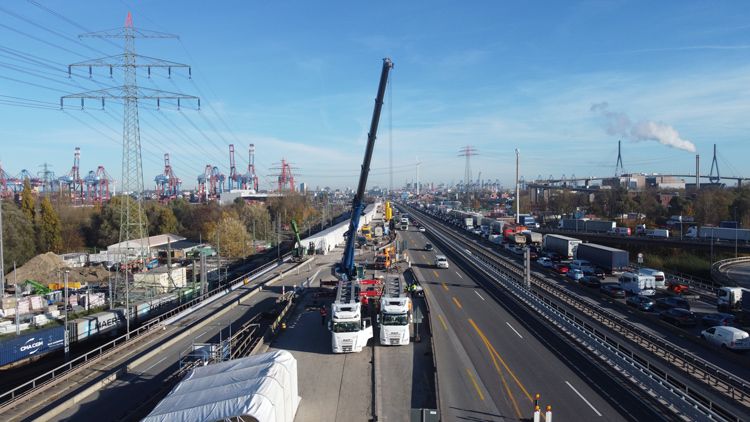
The relevant section of the A7—the elevated K20 highway that stretches for several kilometers through the port area—was originally designed so that it could one day be expanded by an additional lane. That moment had now arrived. However, the structure of the bridge did not allow the new sign gantries to be founded in the usual way on side foundations next to or on the roadway. Instead, all supports had to be installed beneath the motorway bridge—some in swampy ground, some directly above water. This meant foundations under extremely difficult conditions, drilled piles in harbor sludge, work with floating pontoons, negative climbing systems, and special platforms—plus supports rising up to seventeen meters high to safely guide the structures over the carriageway.
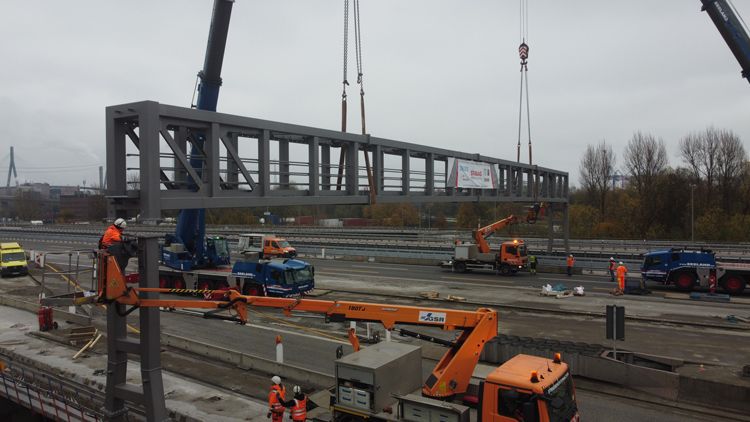
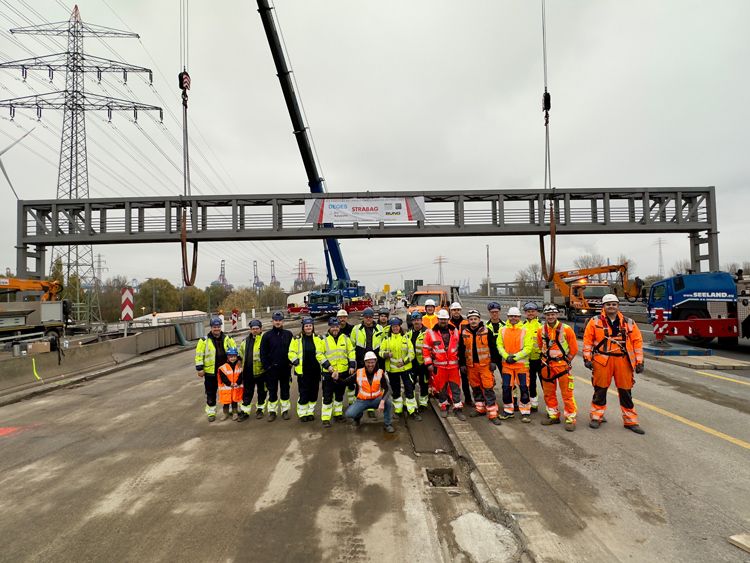
One of the greatest challenges was installing the longest overhead structure of the entire project: the crossbeam of the sign bridge with a span of 43 meters and a weight of around 40 tons. The massive steel beam was delivered in four parts and preassembled by SWARCO during installation week using nearly 200 high-strength (HV) bolted connections. Each HV bolt was tightened to 800 Nm. For comparison, a car wheel bolt is typically tightened to around 120 Nm. For the actual lifting operation, SWARCO used heavy equipment, including two 250-ton mobile cranes that hoisted the beam into its final position in a precisely coordinated tandem lift—an operation where every single movement had to be perfect.
Smoother traffic around the Elbe Tunnel and the port
Reduced risk of congestion and shorter travel times
Improved safety through modern traffic control
A contribution to reducing CO₂ and pollutant emissions
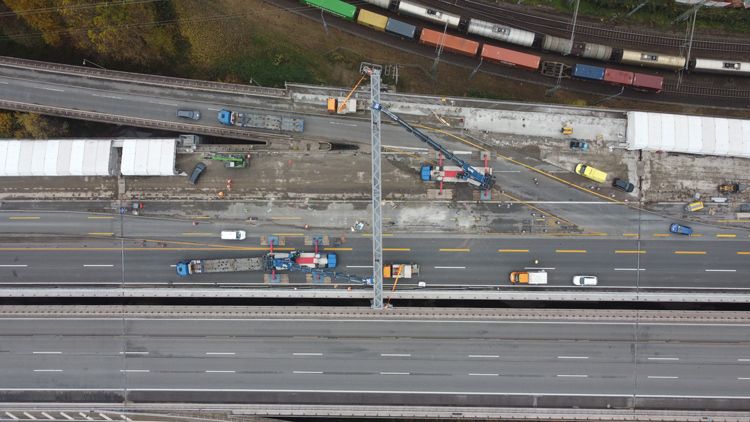
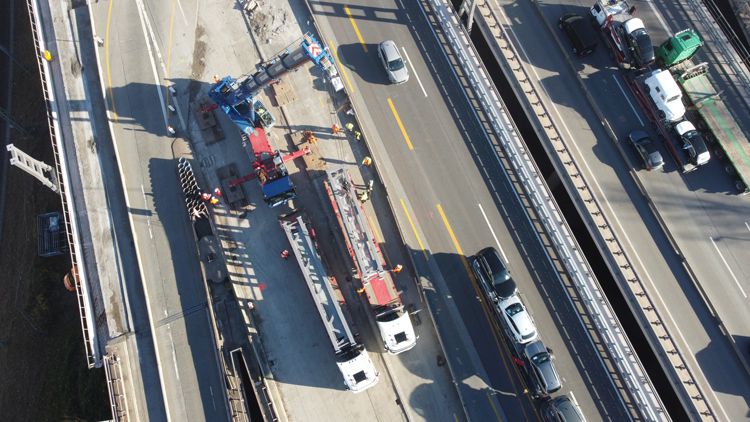
The project has demonstrated just how much expertise, precision, courage for special solutions, and team spirit are embedded in SWARCO’s interurban capabilities. In an environment that rarely allows routine—and where every decision has an immediate impact on hundreds of thousands of road users—SWARCO has proven that even extraordinary challenges can be mastered with professionalism and passion.
Phillipp Groos sums it up with a smile: “We do standard projects every day. But this one—it made all of us grow a little. I don’t think I’ll ever experience another project in my entire career with such a variety of special solutions. And that’s exactly why we do this job.”
The Better Way. Every Day.