

How skid resistance can save lives
Whether on foot, by bike, or by car – road traffic requires skid resistance. The surface texture of road markings influences braking distances and can reduce the risk of slipping and skidding. How does SWARCO Road Marking Systems incorporate this aspect into its marking systems?
It is drizzling, and the road glistens wet in the street lamps' light. A pedestrian takes her first step onto the zebra crossing, while a few metres away, a cyclist carefully rolls over the red-marked bike lane. Suddenly, the tyre slips slightly but immediately regains its traction. This is no coincidence, but the result of an optimised surface texture: skid-proof road markings that provide a secure grip.
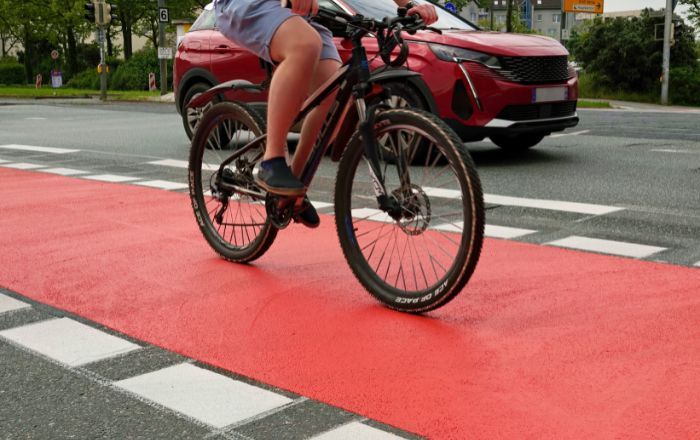
Zebra crossings and bike lane markings are heavily used areas in road traffic. If their surface becomes too smooth, a single misstep or a slipping wheel can have serious consequences. That is why their skid resistance is not a technical detail, but of crucial importance – especially for vulnerable road users. Of course, motorists also benefit from anti-skid markings as well: for example, at stop lines, in bends, or when changing lanes – wherever precise braking, sufficient traction and safe handling are required.
Skid resistance – protecting lives with physics
Skid resistance refers to a surface’s ability to generate friction. It ensures that tyres maintain a secure grip and that shoe soles have firm footing – which can be particularly challenging in rain. Road markings with good skid-resistance can reduce the risk of skidding and shorten braking distances or provide the necessary friction for safely crossing the road. In critical situations, this can make all the difference.
Skid resistance of road markings is measured using the British Skid Resistance Pendulum Tester (SRT device), fitted with a standardised rubber slider, which swings over the surface to measure the energy loss caused by friction. The results are expressed as Pendulum Test Values (PTV). A higher PTV indicates greater friction between the tyre (or shoe) and the surface. Measurements are performed on a wet surface to ensure a consistent and reliable assessment of skid resistance and braking performance; details are described in standards EN 13036-4 or ASTM E 303-22.
SWARCO tested exemplary road markings in Croatia. The results were as follows:
- Asphalt: 42 - 64 PTV (strongly dependent on location and type of surface)
- Road marking paint + glass beads: 40 - 45 PTV
- Road marking paint + glass beads + 20 % anti-skid aggregates: 44 - 49 PTV
- Thermoplastic + glass beads: 58 - 63 PTV
- Thermoplastic + anti-skid aggregates (bike lane marking): 75 - 78 PTV
These results confirm that properly designed road marking systems with anti-skid aggregates can provide higher skid resistance values than the asphalt roadway. This underlines the measurable safety advantage that marked bike lanes or cycle paths offer over untreated road surfaces.
How can skid resistance be achieved?
Modern road markings are sophisticated high-tech systems comprising several components. Road markings always consist of two layers: the marking material that gives the surface its colour adheres directly to the road surface. This is followed by a layer of drop-on materials – mainly reflective glass beads – which make the marking visible in the dark in vehicles’ headlights. At the same time, this layer protects the road marking from abrasion caused by traffic. Anti-skid aggregates that can be intermixed with the drop-on glass beads increase skid resistance and improve abrasion resistance, enhancing long-term durability and safety.
According to the European Standard EN 1423, anti-skid aggregates used as drop-on materials are classified into two types, based on their optical properties:
- Transparent aggregates, such as
- Glass granulate: inexpensive, readily available, but its effect diminishes over time, or
- Corundum: expensive, but highly effective and providing long-lasting effect
- Opaque (non-transparent) aggregates, such as
- Minerals, including varieties of sand: inexpensive and efficient
- Bauxite: very efficient, but its dark colour significantly limits the use
Since anti-skid aggregates can negatively affect colour of road markings (limit their daytime visibility), the question arises: is there an optimal balance between reflective glass beads and anti-skid aggregates? SWARCO recommends adding approximately 20-30% anti-skid material to the glass beads for enhanced friction. This mixing ratio ensures that the markings remain clearly visible, while still providing reliable traction for all road users.
The art of the right system
The type of application of the road markings plays a particularly important role, regardless of the anti-skid aggregates. Structured road markings are naturally rougher and therefore offer better skid resistance than flat line markings. In addition, rainwater can run off them easier because of the ridges and troughs in their structure. Hence, a double advantage: the markings remain more visible even in wet conditions and are also more slip-resistant. It is essential to choose the correct marking system to fully realise these safety benefits.
That is why SWARCO Road Marking Systems continually strives to further enhance its high-quality road marking solutions. Ultimately, adequate friction can make the decisive difference between a vehicle stopping safely or skidding. In the same way, it can also mark the line between a zebra crossing that offers safe footing and one where the pedestrian mentioned at the beginning slips. Moreover, because every infrastructure project is unique, SWARCO experts analyse local requirements and develop tailor-made marking systems to ensure maximum safety and durability.
Crossings, Stop Lines, Arrows
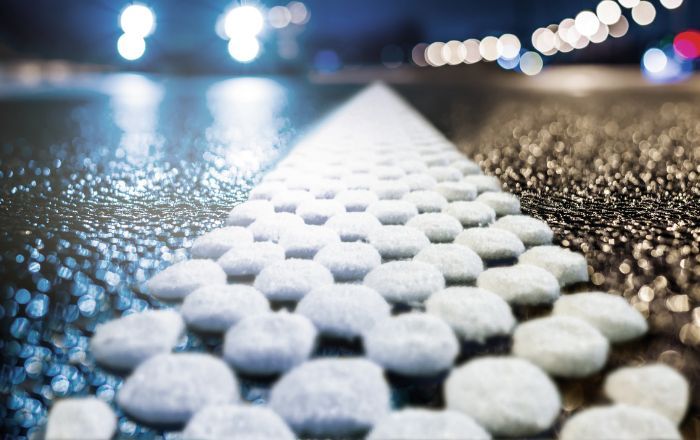
- Structured markings with a layer thickness of 1–5 mm made of cold plastic
- 70% reflective glass beads + 30% anti-skid aggregates
- If the retroreflectivity level (RL value) drops below 100 mcd/m²/lx: thin layer of paint or sprayed cold plastic for reinstatement is suggested
Cycle Paths, Bike Lanes
- Thick layered area marking (2–3 mm) made of cold plastic or thermoplastic (bicycle lane marking systems)
- Corundum + glass granulate as anti-skid aggregates
- Renewal: additional thick layer if more than 5 per cent of the coating has been eroded
Invisible but noticeable safety
The skid resistance of a road marking is not a minor detail, but a central component of an invisible safety net that we drive or cross every day, often without really noticing it. Well-designed marking systems with optimum friction provide orientation, create safety and prevent accidents. SWARCO Road Marking Systems develops appropriate solutions that make every mile of road safer – in all weather conditions, every day.
Why is the skid resistance of road markings so important?
It ensures that tyres and shoe soles find traction on the road. Good surface roughness reduces the risk of slipping or skidding and shortens the braking distance.
What influences the skid resistance of a marking?
It is determined by the combination of substrate, marking material, drop-on materials (reflective glass beads, anti-skid aggregates), and application method. Structured markings offer significantly higher skid resistance than flat line systems.
How is skid resistance measured?
It is determined using the pendulum test (e.g., in accordance with European standard EN 13036-4). A rubber-coated slider simulates the friction between tyres and the surface – the result is given as the PTV (Pendulum Test Value). Various classes of skid resistance are listed in the standard EN 1436.
What PTV value is considered desirable?
A PTV value above 50 (i.e. Class S2 per standard EN 1436) is considered safe, especially for pedestrian crossings and cycle paths. High-performance systems with anti-skid aggregates even achieve values of 70 or more. Note that measurement of skid resistance at structured road markings is not reliable and should not be performed.
What materials are used as anti-skid aggregates in road markings?
Minerals such as corundum, bauxite, or sand; glass granulate can also be used and has the advantage of being colour-neutral.
How long does a marking remain skid-resistant?
This depends on traffic load, weather conditions and material quality. In cases of heavy use, markings should be checked regularly and renewed if their skid resistance or retroreflectivity decreases.

more about
SWARCO Road Marking Systems
About SWARCO Road Marking Systems
Quality products and services from SWARCO Road Marking Systems guide traffic safely from A to B by day and, above all, by night. On all types of roads. Whatever the weather. From a single source. Over 5,000 customers in more than 80 countries place their trust in them.