
HOW TO tackle mobility challenges in Saudi Arabia
As Saudi Arabia charts its transformational course through Vision 2030, the scale and complexity of its mobility challenges are becoming ever clearer. The Kingdom's rapid urbanization and economic diversification bring both challenges and many opportunities.
In our previous article, we highlighted the role of intelligent mobility in the context of the Saudi Vision 2030 and how mobility and transportation act as enablers of transformation. Growing cities, expanding transport demand, entrenched car-culture, scattered systems, air-quality and safety concerns are challenges that will require synchronized efforts in policy reform, technology integration, behavioral change and contextual urban design.
In this article we follow up on these challenges and turn the spotlight onto solutions, the strategic, technological, organizational and behavioural levers that can turn the mobility vision into reality.
NOW, THE QUESTION SHIFTS FROM WHAT THE OBSTACLES ARE to HOW THEY CAN BE OVERCOME.

Together, our goal is to move beyond diagnosis into deployment, outlining actionable pathways for Saudi cities to build intelligent, sustainable, and efficient mobility infrastructures that support the Vision’s ambitions and improve the quality of life for residents and people on the move.
At SWARCO, we believe that intelligent mobility solutions are the key to sustainable growth. Through advanced traffic management, public transport optimization, integrated software solutions, and high-quality road marking systems, we help cities worldwide to overcome today’s challenges and shape the mobility networks of tomorrow.
Article Highlights
Traffic flow & efficiency:
- Reduced congestion and travel time through adaptive signal coordination.
- Real-time situation awareness via centralized dashboards and live visualization.
- Faster response to changing conditions (events, peaks, incidents) using automated, scheduled, or manual actions.
- Predictive analytics to anticipate peak demand and optimize strategies proactively.
- Improved routing and throughput, including dynamic rerouting away from congested areas.
Scalability and future readiness:
- Modular, “start small and expand” capability, allowing cities to incrementally add features as needs evolve.
- Scalable architecture designed to integrate new sensors, transport modes, and innovations over time.
- Future-proofing for connected and autonomous mobility, supported through interoperability and standardized V2X readiness.
- Artificial Intelligence in modern traffic management
Safety outcomes:
- Collision-risk reduction through adaptive signals, dynamic signage, work-zone and tunnel safety solutions.
- Proactive safety targeting by identifying unsafe areas and intersections through data visualization.
- VRU protection through better planning tools, warnings for cyclists/e-scooters, and urban freight redirection.
- School-zone safety measures, including detection of children crossing and daytime speed reduction.
Environmental and livability gains:
- Improved air-quality management by combining pollution-relevant data (weather/climate/environmental sensors) with mobility data.
- Targeted interventions to reduce emissions, especially those caused by congestion, inefficient flow, and parking search traffic.
- Supports national sustainability goals referenced in the text, including Vision 2030 and the Saudi Green Initiative.
Interoperability and governance benefits:
- Breaks down operational silos by integrating data and coordinating actions across systems.
- Enables network-wide coordination, improving how interventions in one area affect conditions elsewhere.
- Unified decision-making across all road users (public transport, pedestrians, cyclists.
Smart and scalable mobility solutions for being fit for the future

With Saudi Arabia’s urban population rising rapidly and new megacities, projects like Quiddiya, Sports Boulevard, King Salman Park or Diriyah, urban traffic will increase.
Additionally, other cities in the Kingdom are expanding, placing immense pressure on existing transport networks, which static infrastructure cannot keep pace with.
Congestion, delays, and inefficient routing can quickly erode the quality of urban life and economic productivity. Road authority policies will become more complex due to the changing state of daily traffic and the long-term increase in vehicle numbers.
Collect data. Implement actions. See results immediately.
In fact, this means that the demand for seamless, data-driven mobility management is greater than ever. SWARCO’s ecosystem of mobility collects and analyzes data from traffic sensors, floating car data, apps, third-party data, parking data, and more. The data is sent to SWARCO’s Mobility Management System, where it is stored, processed, and analyzed. The data is visualized in real-time, allowing different reports to be generated and providing an overview of what is happening on city streets and roads. This will help improve traffic flows and inform future investment plans. With an overview of current or expected traffic conditions, automated, scheduled or manual actions can be performed. For example, adaptive network control automatically predicts and adjusts traffic signal controls to maximize throughput and reduce traffic jams when it is known that traffic will be extra heavy, such as during a major sporting event. Drivers can also be rerouted and directed away from congested areas to avoid traffic jams. Roadside speed controls can be adjusted automatically. The constant feedback from our Mobility Management System enables us to see the results of these actions in real-time, verifying that the desired outcome is being achieved, i.e., improved traffic flow through city roads and streets, and reduced congestion. All supportet by artificial intelligence (AI).
Key benefits:
- Reduced congestion and travel time through adaptive signal coordination
- Real-time situation awareness with centralized control dashboards
- Predictive analytics to anticipate peak loads and adjust strategies accordingly
- Scalable architecture to integrate future transport modes and sensors
- Artificial intelligence and cognitive traffic managment
Making travel safer for everyone

From data collection to increased safety.
SWARCO brings extensive experience in road safety technologies and traffic control, including adaptive signals, dynamic signage, smart construction zone solutions, and road markings. We offer various solutions and products to reduce the risk of driving in or near work zones and in tunnels, helping to prevent accidents and injuries in Saudi Arabia, where road safety remains a critical concern. Our ecosystem of mobility gathers data from all relevant sources, allowing cross-domain applications to be connected and integrated. The data is stored, processed, and visualized to enable appropriate actions to be taken to reduce accidents, especially in the vicinity of road works or in tunnels.
The SWARCO Mobility Management System visualizes unsafe areas and intersections, providing a better understanding of the current traffic situation. Traffic planning and engineering tools can be used to efficiently plan your traffic infrastructure, particularly for VRUs. Traffic, especially heavy trucks, can be redirected from city centers, and drivers can be warned about cyclists or e-scooters in a blind spot by means of digital signs or through app information. Children can be detected crossing the streets near schools, and the speed limit can be reduced in the vicinity of schools during the day.
Start small. Add what is needed.
SWARCO‘s traffic technology has been specifically designed and developed to allow users to incrementally expand their system in direct response to new market innovations or changing mobility needs. The modular system that connects interurban and urban domains integrates micro-, macro-, and cross-domain software, enabling users to start small and add new features when needed. The open SWARCO Mobility Management System better serves the needs for a holistic and comprehensive approach to improved traffic safety!
We leverage decades of experience in road safety and traffic control to deliver integrated safety systems that prevent accidents and minimize their impact.
Our solutions at a glance:
- Dynamic warning systems that adapt to traffic, weather, and visibility conditions
- Automated incident detection in tunnels and highways for rapid emergency response
- Speed management and enforcement integration to encourage safe driving behavior
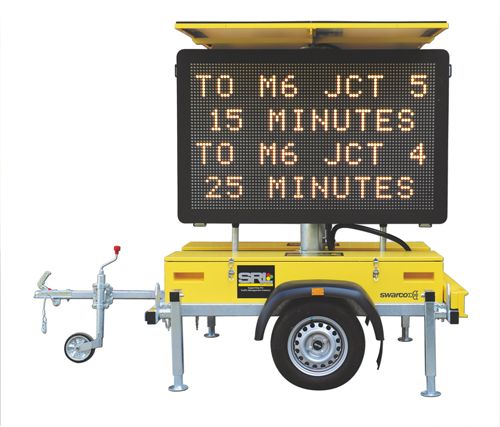
- Variable Message Sings (VMS) to provide timely driver information
- Road markings with our high-quality glass beads for the best visibility in all weather conditions
- Artificial intelligence and cognitive traffic management
SWARCO solutions to improve air quality and urban livability
Day-to-day traffic accounts for approximately 30% of all pollution and is expected to continue increasing. An inefficient flow of traffic, congestion, and searching for a parking space result in multiple hundred tons of CO2 emissions for every city. As cities grow, reducing emissions becomes vital to securing a healthy urban environment and achieving the sustainability targets outlined in Vision 2030 and the Saudi Green Initiative.
From traffic data to coordinated actions.
SWARCO’s ecosystem of mobility enables the collection of all pollution-relevant data from climatic conditions, weather stations, and environmental sensors, as well as connecting with data from traffic sensors, apps, third-party data, parking data, and more. In our mobility management system, the gathered data is stored, processed, analyzed, and visualized to provide a clear picture of a city's situation, with the aim of supporting traffic managers in taking actions to reduce air pollution.
Overcome the lack of interoperability together with SWARCO

At the heart of the problem lies fragmentation. Traffic signal controls, public transport networks, real-time parking systems, ride-hailing platforms, and emergency response units often operate as isolated silos. Each uses its own software, data formats, and communication protocols. Without standardized frameworks or integrated communication channels, these subsystems cannot effectively share information or coordinate their activities.
SWARCO’s approach to tackling this challenge is to build systems that seamlessly integrate heterogeneous data sources, including inductive loops, cameras, floating car data, and connected vehicles. By adopting open standards and modular architecture, cities can integrate legacy infrastructure with modern, adaptive, and predictive traffic control systems. Multimodal data fusion enables traffic managers to consider all road users—public transport, cyclists, pedestrians, and freight—in a unified decision-making framework. Advanced model-predictive control algorithms then optimize traffic flow based on shared priorities, such as safety, sustainability, and public transportation efficiency. Digital twins further enhance interoperability by creating a virtual environment where signals, variable message signs, and dynamic speed regulations are coordinated across the entire network. Through this connected ecosystem, cities gain real-time insight into how interventions in one area impact conditions elsewhere, effectively breaking down operational silos. Interoperable platforms also prepare infrastructure for connected and autonomous vehicles through standardized V2X communication. In this way, SWARCO helps cities transform fragmented systems into cohesive, future-ready mobility networks, enabling smarter decisions, smoother flows, and safer, greener roads for everyone.
Summary
By transforming traditional infrastructure into an intelligent, data-driven mobility ecosystem, SWARCO empowers cities to grow sustainably without relying on constant physical expansion. Our integrated mobility management systems collect, integrate, and analyze data across all modes of transportation to reduce congestion, shorten travel times, and optimize traffic flow, even during peak demand or large-scale events. With advanced safety technologies—from adaptive signals and dynamic warning systems to tunnel incident detection, blind-spot alerts, school-zone protection, and high-visibility road markings—SWARCO can also help Saudi authorities reduce fatalities, enhance driver awareness, and strengthen a proactive safety culture that supports the Vision 2030 Quality of Life Program.
At the same time, SWARCO can support Saudi Arabia’s environmental and livability ambitions by helping cities monitor pollution-critical data and coordinate targeted actions that reduce emissions and improve urban air quality. Through open, modular, and fully interoperable platforms, we offer a holistic approach from a single source, enabling cities to break down siloed systems, ensure smooth integration of new technologies, and prepare their infrastructure for connected and autonomous vehicles and artificial intelligence and cognitive traffic managment.
As the Kingdom expands its urban footprint with megaprojects, SWARCO is the partner that provides know-how in artificial intelligence and cognitive traffic management, along with a scalable, future-proof mobility backbone to support these transformative developments, making the travel experience safer, quicker, more convenient, and environmentally sound.